
The 5 Phases of GTM: A Framework for Building Strategy That Scales
GTM isn't a one-time event. It's a living system that evolves through five distinct phases — each one building on the last.
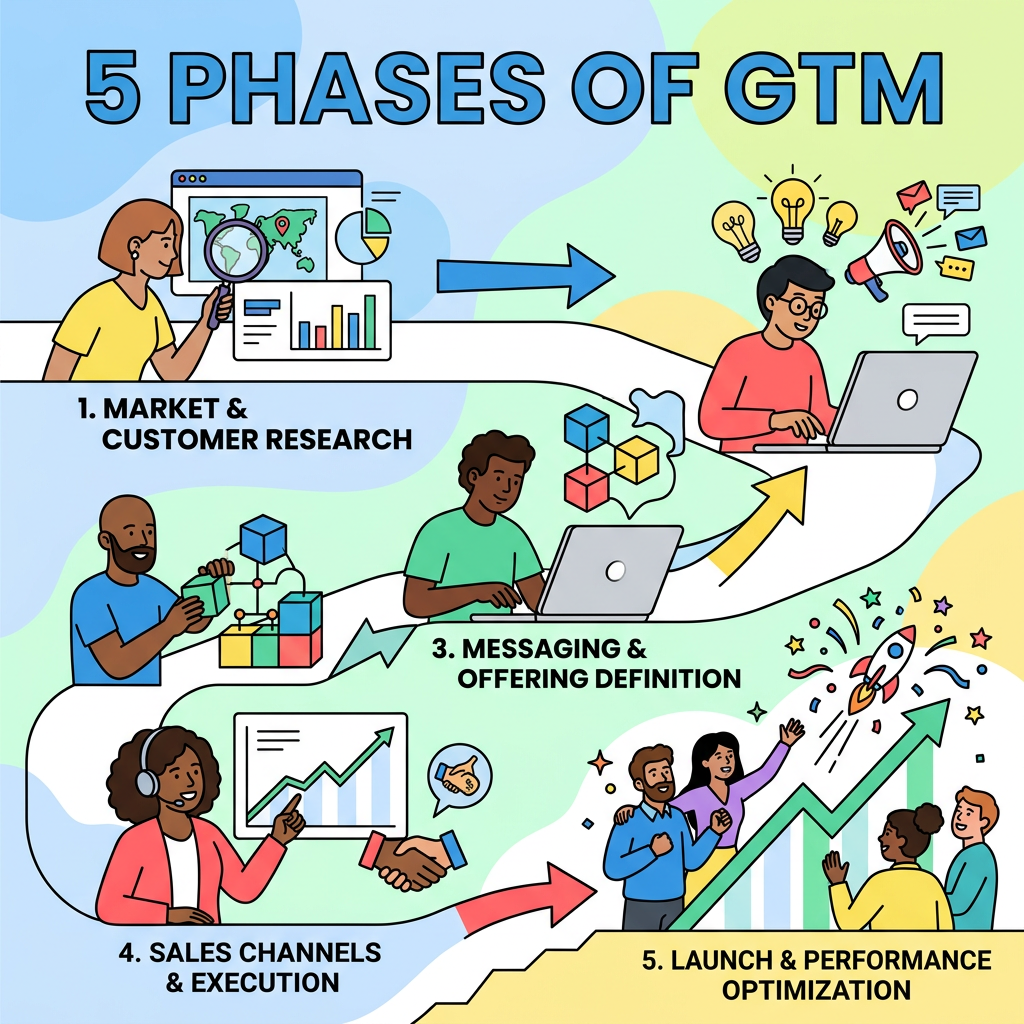
Most teams treat GTM as a launch moment — a burst of activity around a new product, feature, or campaign that eventually fades into the next priority. This approach creates a cycle of rebuilding: every new initiative requires re-litigating the same foundational questions because nothing was ever truly settled.
The 5 Phases of GTM framework changes that. It treats go-to-market not as a project with a start and end date, but as a progressive system — one that compounds in value as you move through each phase, building on validated decisions rather than improvised ones.
Here's how each phase works, what it produces, and what breaks when you skip it.
Phase 1
Foundational
"Who are you, and who are you for?"
The Foundational phase is where you establish the bedrock of your entire GTM system. This isn't strategy — it's the pre-strategy layer that everything else depends on.
Key Activities
- Define your vision, mission, and market thesis
- Identify your total addressable market (TAM) and beachhead segment
- Document the problem you're solving and who experiences it most acutely
- Establish your company's core values and differentiation philosophy
What breaks when you skip this
Teams that skip this phase build positioning on sand. Every pivot costs more than it should because there's no anchor.
Phase 2
Alignment
"Is the whole organization rowing in the same direction?"
The Alignment phase ensures that every function — product, marketing, sales, customer success — is operating from the same strategic playbook before you invest in execution.
Key Activities
- Define ICP and build buyer personas tied to your market definition
- Align on positioning and differentiation across stakeholders
- Build your messaging architecture and validate it internally
- Establish shared metrics and success criteria across teams
What breaks when you skip this
Misalignment at this stage is invisible until it's expensive. It shows up in late-stage deal losses, campaign underperformance, and high churn.
Phase 3
Product Fit
"Does your market actually validate what you've built?"
Product Fit isn't just about product-market fit in the startup sense — it's about ensuring your product narrative, pricing, and positioning are validated by real buyer behavior before you scale.
Key Activities
- Map product capabilities to specific buyer outcomes
- Validate pricing and packaging against competitive alternatives
- Run win/loss analysis to understand where and why you win
- Gather customer evidence: case studies, testimonials, usage data
What breaks when you skip this
Companies that skip validation often scale the wrong thing. More leads, more spend, more headcount — all amplifying a message the market isn't responding to.
Phase 4
Activation & Launch
"How do you get to market with precision?"
Activation is where strategy meets execution. But unlike traditional launch planning, a structured Activation phase is grounded in everything you've built in the previous phases — so every motion is purposeful.
Key Activities
- Build launch playbooks tied directly to your positioning and ICP
- Equip sales with battle cards, objection guides, and demo frameworks
- Execute demand generation campaigns with segment-specific messaging
- Coordinate product launches with sales readiness and marketing timing
What breaks when you skip this
Launching without a validated foundation creates noise without signal. You'll generate activity, but conversion will disappoint.
Phase 5
Optimize & Scale
"How do you make what's working, work harder?"
Optimize & Scale is the ongoing operational phase where you treat GTM as a living system. You instrument feedback loops, respond to market signals, and continuously improve every pillar.
Key Activities
- Instrument win/loss data and feed it back into positioning
- Run quarterly GTM reviews across all pillars
- Expand into adjacent segments using the same structured framework
- Scale channels, content, and enablement based on what's proven to convert
What breaks when you skip this
Companies that stop at launch often find themselves rebuilding strategy from scratch every cycle. Optimize & Scale ensures you compound your learning instead of resetting it.
Why the Sequence Matters
The phases aren't arbitrary. Each one produces outputs that are inputs to the next. You can't build effective messaging (Phase 2) without a validated ICP (Phase 2 requires Phase 1). You can't run effective campaigns (Phase 4) without validated positioning (Phase 3). You can't scale (Phase 5) without knowing what's actually working (Phase 4 instrumentation).
Teams that jump ahead — running campaigns before messaging is validated, or scaling before product fit is confirmed — amplify their mistakes instead of their wins. More budget, more headcount, more tools — all accelerating toward a wall.
GTM Is Never "Done"
Phase 5 is called Optimize & Scale — not "complete." Once you've built through the first four phases, you enter a continuous cycle of measurement, learning, and refinement. The market changes. Competitors respond. Buyers evolve. The teams that win long-term are the ones that treat their GTM strategy as a living system, not a historical document.
If you're in Phase 1 today, the goal isn't to rush through the phases — it's to do each one well enough that the next one is easier. Foundation compounds. Skipping it costs more than you think.
See all 5 phases in one platform.
VergenticAI structures your entire GTM strategy across all five phases — scored, connected, and ready to execute.
Start Free TrialTry VergenticAI and build your GTM foundation in days—not weeks.
Start with a 7-day trial to explore the full platform. If it's not a fit, cancel anytime. If it is, you'll have a GTM system you can build on—without losing alignment.
7-day free trial · No credit card required · Cancel anytime