
Why Most GTM Strategies Fail Before They Even Launch
Brilliant products die in the market every day. Not because of bad engineering or bad timing — but because of a broken GTM foundation.
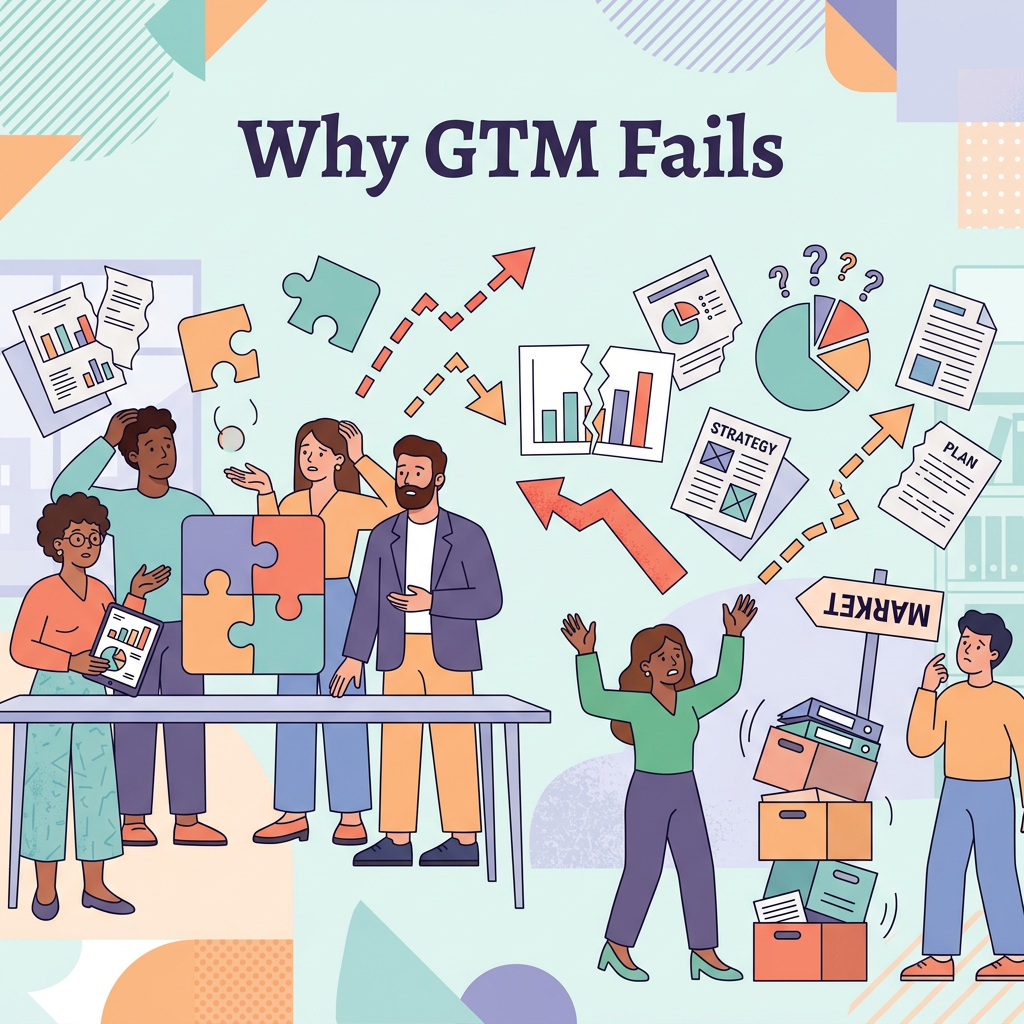
The graveyard of great products is vast. Inside it, you'll find category-defining ideas, technically superior solutions, and genuinely innovative teams — all of whom made the same category of mistake: they treated GTM as a final step rather than a foundation.
GTM failure isn't dramatic. It's slow. It looks like stagnant pipeline, low win rates, endless positioning debates, and sales teams rewriting their own decks because the official messaging doesn't resonate. It feels like friction everywhere — and it almost always traces back to the same root causes.
Here are the six most common reasons GTM strategies fail — and what to do instead.
1. No Clear ICP — Selling to "Everyone"
When your ideal customer is undefined, your messaging has to appeal to everyone — which means it resonates with no one. This is the most common and most expensive GTM mistake.
Teams that haven't defined their Ideal Customer Profile (ICP) spend enormous resources acquiring customers who churn, escalate, or never fully adopt. They win the wrong deals. They lose the right ones because their pitch isn't specific enough.
Specificity is not a limitation — it's a magnet. The more precisely you can describe who you're for, the more powerfully you attract them. See our article on ICP vs. Persona for a deeper breakdown of how to get this right.
2. Positioning Built on Features, Not Outcomes
Most companies position around what their product does. The best companies position around what their customers achieve.
Feature-based positioning creates comparison fatigue. When buyers evaluate solutions, they compare feature lists — and if you're just one feature away from a competitor, price becomes the deciding factor. Outcome-based positioning reframes the conversation around what matters most: the result.
If your positioning statement reads like a product spec sheet, it's not doing its job.
3. Messaging Disconnected from Positioning
Even companies with solid positioning often fail at the translation layer. Positioning is the strategic choice. Messaging is how you communicate it — across channels, audiences, and moments.
When messaging is written independently of positioning (usually by a content team working from a brief instead of a strategy), it drifts. Different landing pages say different things. Sales decks contradict the website. Campaigns attract leads that sales can't close.
Messaging must flow from positioning — not be written alongside it. Read more in our guide on Positioning vs. Messaging.
4. No Competitive Frame of Reference
Buyers don't evaluate products in a vacuum. They evaluate them relative to the alternatives — including the alternative of doing nothing. GTM strategies that ignore this dynamic are perpetually surprised when deals don't close.
A strong GTM strategy maps the competitive landscape explicitly: who the alternatives are, where you win, where you lose, and what questions you need to answer before a deal gets to late stage. Without this, your team improvises in every competitive situation — and improvisation in sales is expensive.
5. Sales and Marketing Operating from Different Playbooks
This is the most common organizational symptom of a broken GTM system. Marketing builds campaigns targeting one audience. Sales pursues a different one. Marketing produces content the sales team never uses. Sales makes promises the product can't keep.
The root cause isn't cultural — it's structural. When there's no single shared source of truth for strategy, every team builds their own interpretation. Alignment isn't a retreat or a shared Slack channel. It's a system. See our full breakdown in GTM Alignment.
6. Launching Without a Feedback Loop
Perhaps the most avoidable failure: launching a GTM strategy and treating it as complete. Markets move. Buyers evolve. Competitors respond. A strategy built in Q1 without a mechanism to incorporate what you're learning in Q2, Q3, and Q4 becomes stale — and a stale strategy is often worse than no strategy, because it creates false confidence.
The best GTM organizations treat strategy as a living system — continuously scored, updated, and refined based on what the market is telling them. Win/loss data, customer interviews, rep feedback, churn signals — all of it feeds back into the strategy and sharpens it over time.
The Common Thread
Every one of these failures has the same underlying cause: GTM strategy was treated as a one-time output rather than an ongoing system. A pitch deck, a launch doc, a set of talking points — not a connected, validated, scored framework that the whole team operates from.
Fixing it doesn't require starting over. It requires building the foundation correctly — and then maintaining it.
Video Summary

Stop guessing. Start building GTM with structure.
VergenticAI scores your strategy in real time and tells you exactly where the gaps are — before they cost you deals.
Start Free TrialTry VergenticAI and build your GTM foundation in days—not weeks.
Start with a 7-day trial to explore the full platform. If it's not a fit, cancel anytime. If it is, you'll have a GTM system you can build on—without losing alignment.
7-day free trial · No credit card required · Cancel anytime